
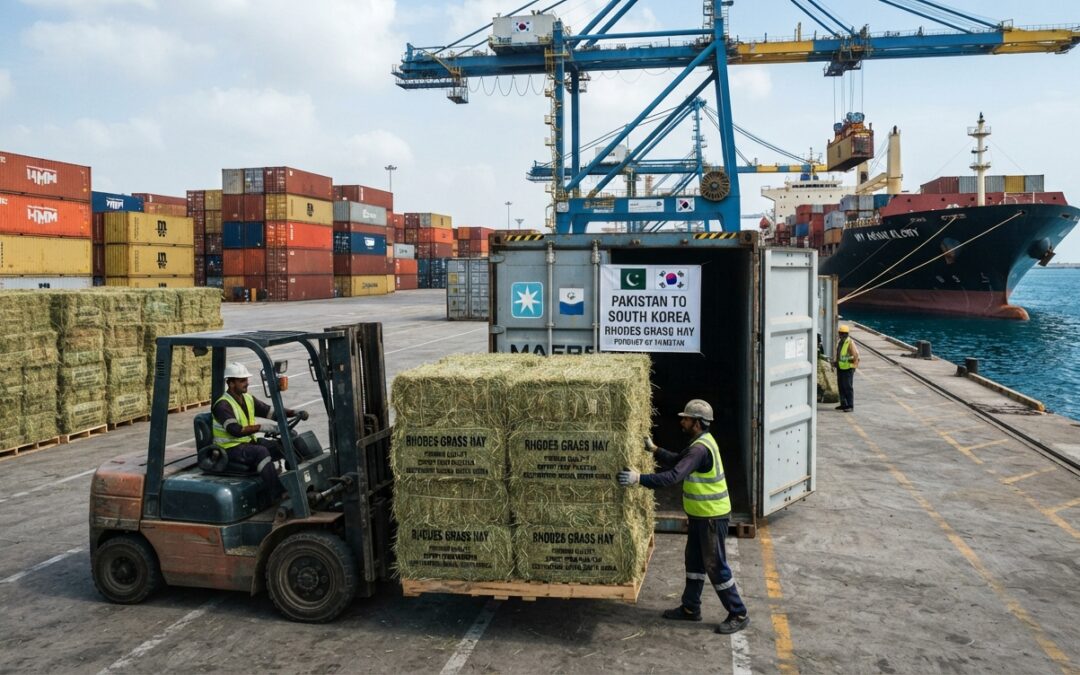
How Pakistan Rhodes grass hay is becoming a key forage import for Korea’s dairy and livestock industry — quality, logistics, and what Korean buyers need to know.
Drive through the irrigated plains of interior Sindh or southern Punjab during peak growing season, and you’ll see it — tall, wiry stands of Rhodes grass swaying in rows that stretch toward the horizon. To the untrained eye, it’s just grass. To anyone paying attention to South Asia’s export economy, it’s quietly become one of the more interesting agricultural stories of the last decade: a forage crop native to Africa, naturalized in Pakistan, and increasingly baled, compressed, and shipped halfway across the world to feed dairy cows in South Korea.
This isn’t a niche curiosity anymore. It’s a real supply chain, with real demand behind it, and Pakistan is positioning itself as a serious player.
Why Rhodes Grass, and Why Now: The Basics Behind the Korea Import Demand
Rhodes grass — Chloris gayana, if you want the botanical name — is a warm-season perennial that thrives in exactly the kind of climate Pakistan has in abundance: hot, dry, and dependent on irrigation rather than rainfall. It was first introduced from Africa over a century ago and has since been cultivated across Australia, the United States, and much of the Middle East as high-quality livestock fodder. What makes it valuable isn’t just that it grows well in tough conditions — it’s what happens after it’s cut.
Rhodes grass dries fast, holds its structure well during baling and compression, and retains strong nutritional value even after long transport times. That last point matters enormously when you’re talking about a product that has to survive weeks at sea. Alfalfa and other high-protein forages bruise, mold, and lose quality under those conditions far more easily. Rhodes grass, cut and cured properly, doesn’t.
That durability is exactly why countries with limited arable land for forage production — Korea being a prime example — have turned to imported hay as a structural part of their livestock industry, not an emergency measure.
Korea’s Forage Problem — Why Rhodes Grass Hay Import to Korea Keeps Growing
South Korea has one of the most intensive dairy and livestock sectors in Asia relative to its size, but it has almost no spare land to grow the roughage that sector depends on. Mountainous terrain, dense urbanization, and a small agricultural land base mean Korean dairy and cattle operations have relied on imported forage for decades — historically leaning heavily on American alfalfa and Australian oaten hay.
But shipping costs, currency fluctuations, and increasingly unpredictable weather patterns in traditional supplier countries have pushed Korean forage importers to diversify their sourcing. Pakistan, with its year-round Rhodes grass growing capacity in Sindh and Punjab, lower production costs, and improving export infrastructure, has stepped into that gap. It isn’t replacing Australian Rhodes grass or American alfalfa outright — but Pakistan Rhodes grass export volumes are carving out a real share of the Korea livestock feed import market, particularly for mid-tier forage where price-to-quality ratio matters more than premium branding.
What Makes Pakistan Rhodes Grass Export Competitive for Korean Buyers
A few things converge here, and it’s worth being honest about both the strengths and the friction points.
On the strength side: Pakistan’s growing season for Rhodes grass runs long — sowing from February through October in most regions — which means multiple cutting cycles per year rather than the single or double harvest common in temperate climates. The first cut is typically ready within 50 days of sowing, with subsequent cuts following at roughly 30-day intervals. That kind of turnaround gives Pakistani producers a volume advantage that’s hard to match. Labor costs are also significantly lower than in Australia or the U.S., which shows up directly in export pricing.
Soil and water conditions in irrigated tracts of Punjab and interior Sindh suit the crop well, and Rhodes grass’s tolerance for periodic flooding — while still needing good drainage — fits the canal-irrigation patterns common across those regions.
On the friction side: consistency is the real challenge. Korean buyers, like most serious forage importers, care enormously about moisture content, bale density, protein percentage, and freedom from contamination — weeds, mold, foreign material. This is where Pakistan’s export sector still has work to do. The gap between a well-run export-focused farm and a smallholder operation growing for the domestic feed market can be significant, and that inconsistency is the single biggest obstacle to Pakistan scaling its share of the Korean market further.
The exporters who are succeeding are the ones treating this like the precision agriculture business it needs to be — controlled cutting windows, proper field curing before baling, moisture testing, and compression standards that match what international buyers actually specify in their contracts. That’s not a small thing. It’s the difference between a one-off container sale and a repeat buyer relationship.
The Logistics Reality: Shipping Rhodes Grass Hay from Pakistan to Busan and Incheon
Getting Rhodes grass from a field outside Multan to a dairy operation in Korea involves more steps than people assume: cutting and field curing, baling, compression into export-density bales (loose hay simply isn’t economical to ship), containerization, port handling — usually through Karachi — and then a multi-week sea transit to Korean ports like Busan or Incheon, the two main entry points for hay and forage imports into the Korean market.
Every one of those steps is a point where quality can degrade if it isn’t managed properly. Moisture that isn’t fully reduced before baling leads to mold risk in transit. Inconsistent compression wastes container space and drives up per-ton shipping costs. None of this is exotic knowledge — it’s standard practice in mature forage-export economies — but it requires investment and discipline that not every Pakistani producer has made yet.
Frequently Asked Questions: Rhodes Grass Korea Import
Is Pakistan Rhodes grass suitable for the Korean dairy industry? Yes. Pakistan-grown Rhodes grass hay meets the moisture, density, and nutritional benchmarks most Korean dairy and cattle operations require, provided it’s sourced from exporters using proper field-curing and export-grade compression standards.
Which Korean ports receive Rhodes grass hay shipments from Pakistan? Busan and Incheon are the primary Korean ports handling forage and hay imports, including Rhodes grass shipments from Karachi.
How does Pakistan Rhodes grass compare in price to Australian or American forage exports to Korea? Pakistan’s lower labor and production costs generally make its Rhodes grass hay export more price-competitive than Australian oaten hay or American alfalfa, while still meeting comparable protein and quality specifications when sourced from established exporters.
What is the typical Rhodes grass harvest cycle in Pakistan for export? Sowing runs from February through October across Punjab and Sindh, with a first cut ready in about 50 days and subsequent cuts roughly every 30 days — giving Pakistani exporters multiple harvest cycles per year to supply consistent volume to Korean buyers.
Where This Is Heading
The trajectory is worth watching. As Korean livestock and dairy demand continues to grow and traditional suppliers face their own climate and cost pressures, there’s real room for Pakistan to expand its footprint — provided the export side of the industry keeps professionalizing. That means better on-farm quality control, more consistent export-grade processing infrastructure, and exporters who understand that Korean buyers aren’t just purchasing a commodity — they’re purchasing a specification that has to be hit, shipment after shipment.
Rhodes grass won’t make headlines the way major crops do. But in the quiet economics of livestock feed — where a half-percentage-point difference in protein content or a slightly wetter bale can mean the difference between a renewed contract and a lost buyer — Pakistan’s growing role in supplying Korea says something real about where this country’s agricultural export sector is headed: not just toward bigger volumes, but toward the kind of precision and reliability that international buyers actually pay for.
That shift, more than any single shipment, is the story worth paying attention to.
Recent Comments